
Where it started
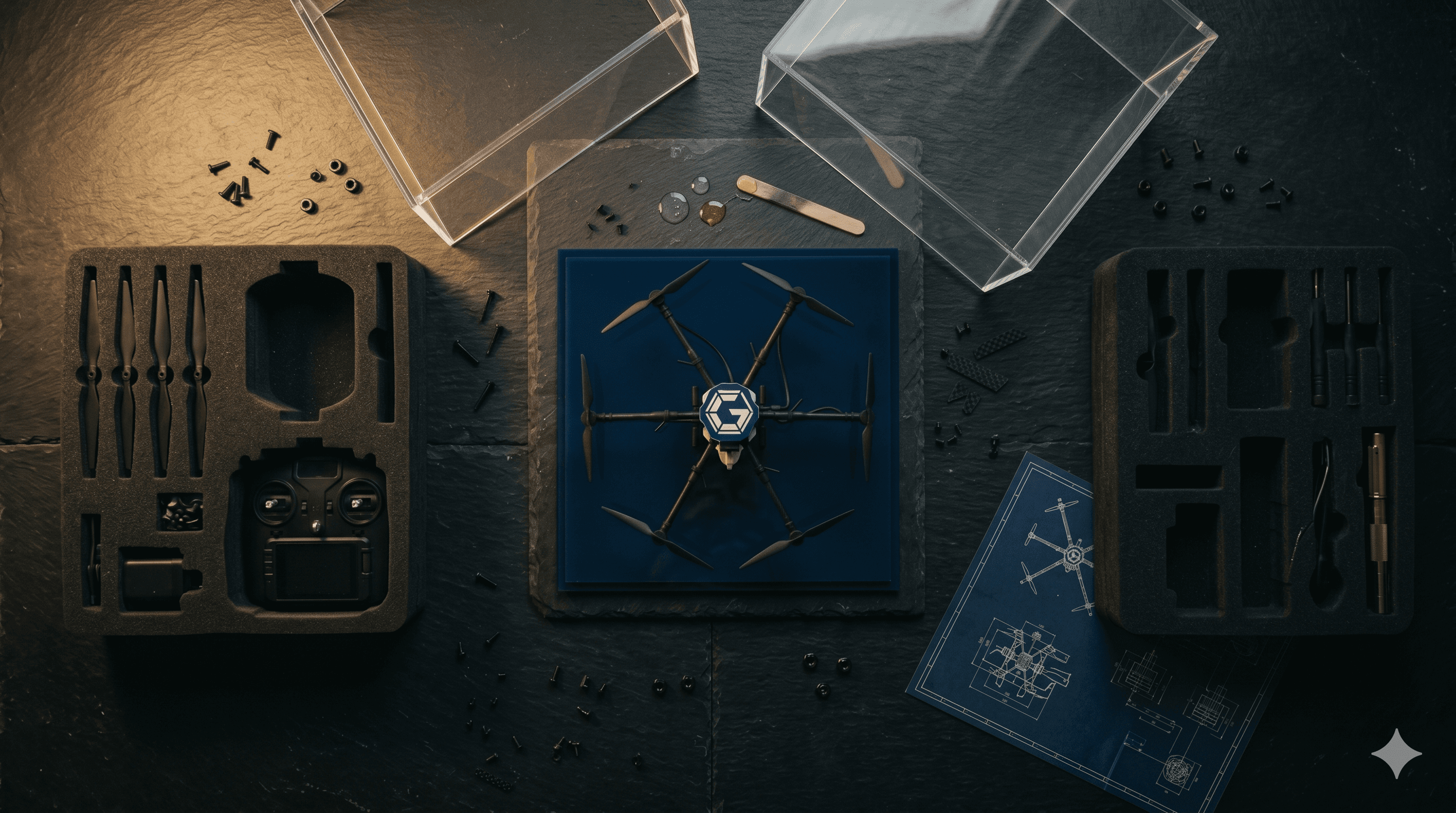
The client wanted something memorable. Not a pen, not a trophy, not another acrylic plaque. They wanted a custom resin hexacopter drone — six arms, six propellers, fully detailed — sealed inside a clear display case on a deep blue base. Something that would sit on a desk and make people ask questions.
We made a sample. They approved it. The sample shipped to Chennai — and arrived broken.
One cracked piece. That is all it took to make the stakes clear. The order was 100 units. The client had an event date. There was no room for a repeat.
"One broken sample was the brief that no document could have written. It told us exactly what we were up against."
Chapter 1 — The production gauntlet
Producing a single clean resin drone is hard. Producing a hundred of them — identically, reliably, on a deadline — is a different problem entirely. Resin printing at this level of geometric complexity is unforgiving. The model had thin arms, cantilevered propellers, and fine underbody detail. Every variable in the process had an opinion about whether it would survive.
The early prints did not make it. There were failures — pieces that looked promising coming off the machine and fell apart under inspection. Geometry that printed clean on the outside and hid stress fractures within. The team iterated hard: orientation, support density, post-processing, cure times. Each failed piece was a data point. Each data point narrowed the window.
"You do not get to unit 100 without earning it. Every failure in the first few prints was tuition we paid so the client did not have to."
When the process finally locked in, it locked in completely. The prints came off consistent — arms intact, props crisp, surface finish clean across every single unit. The team ran quality checks piece by piece. Anything that did not meet the mark did not make it into a box. By the time production closed, every one of the 100 drones going to Chennai had been looked at, approved, and set aside with intention.
Chapter 2 — The night of the foam
The broken sample had taught us one thing above everything else: the drone could not move. Not a millimetre. Not inside the case, not inside the carton, not across 1,350 kilometres of highway, toll plazas, and speed bumps.
It started at the base. Before a single drone went into a box, each one was epoxy-bonded directly to its blue display base — a precise application of two-part structural adhesive at the centre hub, then a four-hour cure. No rattling, no shifting, no coming loose mid-journey. The drone and the base became one object. That was step one.
Step two was the foam. A custom two-piece insert system — a dense base layer with a hand-cut cavity shaped precisely to the drone body, and a softer top layer pressing gently over the propellers with just enough resistance to hold everything completely still without stressing the fragile parts. The display case closed over it all. Locked. Silent. Safe.
The foam arrived from the supplier. The cutting started. By hand, one by one, working from printed templates, running a hot-wire cutter through block after block — 100 base pieces, 100 top pieces. The work went deep into the night.
"Somewhere around the sixtieth foam cut, it stops feeling like production and starts feeling like a promise you are making to the person who is going to open the box."
Packed units went into master cartons — 20 pieces each, double-wall corrugated, foam sheeting between every layer. FRAGILE. THIS SIDE UP. DO NOT STACK.
Chapter 3 — The road over the runway
Sunday evening. Packing done. 100 units in five master cartons. Air cargo was on the table — faster on paper, two hours in the sky. But air cargo means hand-offs: ground handlers, conveyor belts, cargo holds shared with freight that does not know it is sitting next to something fragile.
We chose the tempo. One vehicle. One driver. Our cargo loaded under our hands, not touched again until Chennai. Slower — yes. But every kilometre of that journey was our cargo, our responsibility, our control.
Mumbai to Chennai. 1,350 kilometres. NH44. Cartons strapped to the walls, two high maximum, driver briefed. The tempo pulled out of Mumbai late Sunday night and rolled into Chennai on Monday — every carton intact, every epoxy-set drone inside exactly as it was packed.
What we built
100 units dispatched. 100 units delivered. Zero breakages.
The broken sample started this. It forced HO3D to build something that did not exist before — a complete, proven, end-to-end production and delivery system for complex resin mementos at scale. The print process is locked. The bonding and packaging design is templated. The logistics protocol is documented.
The next client who needs 100 custom mementos delivered without a scratch inherits everything we earned on this one. That is what operations excellence looks like when it compounds.